 EN

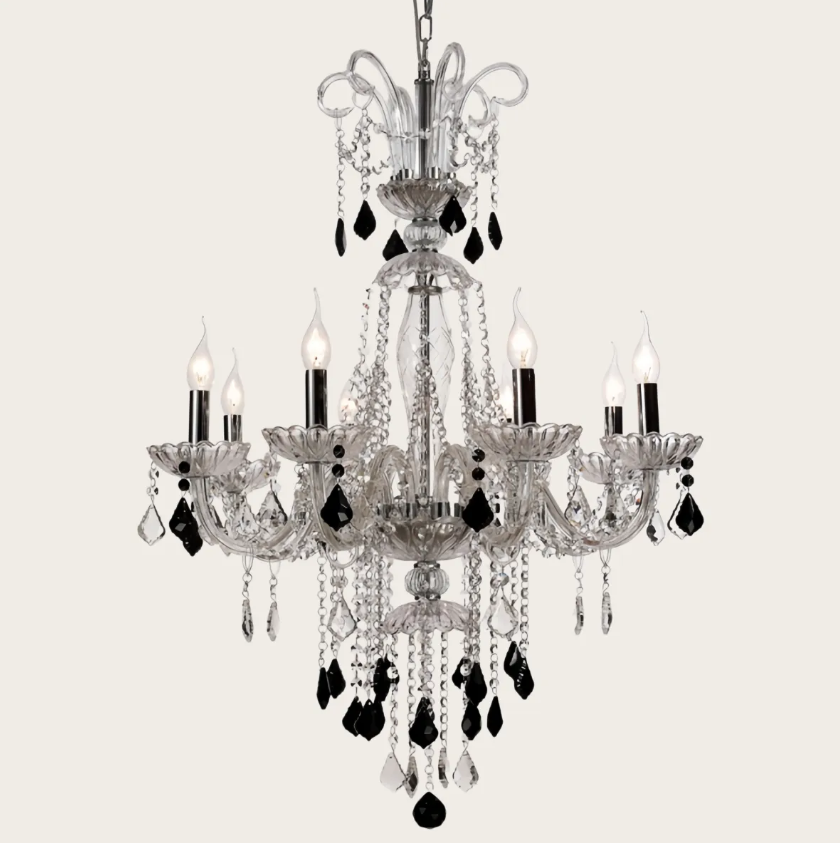
Crystal Chandeliers Are Not Competing With Track Lighting
The first instinct when someone mentions a chandelier in a gallery is to assume it belongs to the architecture, not to the collection. That assumption is usually right. A crystal fixture hanging from a historic ceiling is part of the room's identity, not a tool for rendering pigment accurately on a canvas three meters away. The interesting question is not whether a chandelier can replace a properly aimed spotlight. It cannot. The question is whether a crystal fixture, specified and retrofitted with the right light source, can carry the ambient layer of a gallery's lighting scheme while contributing something that a grid of recessed downlights never will.
That distinction matters because gallery lighting is never one system. It is a stack of systems. Conservation lighting handles exposure and spectral damage. Accent lighting handles focus and modeling. Ambient lighting handles orientation, comfort, and the emotional temperature of the room. A crystal chandelier belongs to that third layer, and when it is treated as decorative infrastructure rather than as the primary light source, it earns its place.
The Optical Case Rests on the Source Inside the Crystal
A crystal chandelier is a delivery mechanism. The crystal prisms refract and scatter whatever light the lamps inside produce. If the lamps are ordinary tungsten or poorly filtered halogen, the fixture becomes a glare source with a warm color cast and a measurable infrared load. If the lamps are modern LEDs selected for museum use, the fixture becomes something else entirely.
The evaluation standard for museum light sources is not complicated at the top level. The IES guidance is blunt: museum lighting should have no ultraviolet and no infrared radiation. LEDs, by their operating principle, do not emit meaningful UV or IR. The damage that fades dyes and embrittles paper happens largely outside the visible spectrum, and an LED source inside a crystal fixture removes that specific pathway almost entirely. What remains is visible light, and that is where color quality becomes the deciding variable.
A chandelier intended for a gallery needs a source with a color rendering index high enough to avoid shifting the apparent color of adjacent works. The general museum benchmark sits at Ra 90 or above for faithful rendering. Some crystal fixtures built for gallery and museum reception environments are now specified with sources in the high 90s, which puts them in the same optical conversation as dedicated accent fixtures. The crystal itself does not improve the color rendering of the lamp. It redistributes the light. The quality has to come from the source.
Glare Is the Failure Mode That Specification Must Anticipate
The historical criticism of crystal chandeliers in serious viewing environments is not about color. It is about glare. A bare crystal prism catching a bright lamp at the wrong angle throws a point of luminance into a visitor's field of view that the eye reads as discomfort, and discomfort shortens dwell time in front of a work. This problem is old enough to appear in patent literature from the early twentieth century, where inventors were already trying to retain the “artistic value” of the crystal fixture while addressing its “harmful and irritating glare”.
The solution is not to remove the crystals. It is to control the relationship between the lamp, the crystal, and the viewer's eye line. Three practical moves appear repeatedly in gallery retrofits:
-
Mount the fixture higher than a residential installation would place it, so the brightest refracted points sit above the visitor's cone of vision.
-
Use diffusing elements or frosted inner cylinders around the lamps so the crystal receives a softer source and produces a broader, lower-intensity field of refraction.
-
Keep the chandelier on a separate dimming circuit from the conservation and accent layers, so its output can be dropped during sensitive viewing periods without affecting the light on the works themselves.
None of these are exotic. They are the same glare-control logic used on any decorative fixture, applied with gallery tolerances rather than ballroom tolerances.
Where Crystal Fixtures Actually Earn Their Keep: Historic and Transitional Spaces
The strongest case for a crystal chandelier in a gallery context is not a white-cube contemporary space. It is the renovation of a historic building where the fixture already exists, or where the architecture demands a decorative centerpiece and the conservation brief forbids uncontrolled light.
The Frick Collection renovation in New York is a useful reference because the lighting team did not treat the historic chandeliers as untouchable antiques or as obsolete relics. Miniature LED accent lights were integrated into the refurbished chandeliers in the second-floor galleries, spaces that had previously been closed to the public. The chandelier remained the visual object it had always been, but it also became a concealed delivery point for precise accent light. That is the model. The crystal fixture does not compete with the conservation lighting scheme. It becomes part of the infrastructure, carrying a layer that would otherwise require visible surface-mounted hardware.
The Maintenance and Conservation Realities That Should Shape the Decision
A crystal chandelier in a gallery introduces two operational burdens that track lighting does not. The first is dust. Crystal prisms have edges, facets, and suspension points that collect particulate matter, and a dusty crystal surface scatters light less predictably than a clean one. In a gallery with a conservation-grade air handling system, the dust load is lower than in a residential room, but it is not zero. Cleaning cycles have to be written into the maintenance protocol, and the cleaning method has to avoid introducing moisture or residue that could affect the fixture's finish or the surrounding wall surfaces.
The second burden is light exposure accounting. CIE 157:2004, the international standard for controlling optical radiation damage to museum objects, sets cumulative exposure limits for sensitive materials and recommends keeping track of both intensity and duration. A chandelier that runs for the full operating day contributes to that cumulative dose just as surely as a spotlight does. If the fixture is on the same circuit as the general room lighting and cannot be dimmed or switched independently, it becomes an uncontrolled variable in the exposure budget. Independent dimming and a clear operational schedule are not optional in a collection environment. They are the price of using a decorative fixture in a conservation-conscious room.
What a Workable Specification Looks Like
A gallery chandelier that performs well is specified from the inside out, not from the crystal cut outward. The sequence that holds up in practice starts with the source: LED, high color rendering, no meaningful UV or IR output, dimmable to a low threshold without color shift. The optical assembly comes second: diffusion around the lamps, a beam pattern that washes the upper volume of the room rather than punching a bright spot onto a wall, and a mounting height calibrated to the visitor's eye line. The crystal and frame come third, because those are the visual decisions that should be made once the light behavior is already solved. And the controls come last but matter most: a dedicated dimming channel, a schedule tied to gallery hours, and documentation that lets the conservation team account for the fixture's contribution to cumulative exposure.
Andiwilson's production approach reflects this inside-out logic, with source selection, optical assembly, and finish development handled within a coordinated manufacturing flow rather than assembled from separate vendor catalogs. That matters in gallery work, where a fixture that looks correct but behaves like a residential chandelier becomes a maintenance and conservation problem within the first year of operation.
Table of Contents
- Crystal Chandeliers Are Not Competing With Track Lighting
- The Optical Case Rests on the Source Inside the Crystal
- Glare Is the Failure Mode That Specification Must Anticipate
- Where Crystal Fixtures Actually Earn Their Keep: Historic and Transitional Spaces
- The Maintenance and Conservation Realities That Should Shape the Decision
- What a Workable Specification Looks Like