Walnut Solid Hardwood Flooring: Color-First, Maintenance-Aware Specs

Get a Free Quote

Our representative will contact you soon.
Email
Mobile/WhatsApp
Name
Company Name
Message
0/1000

A Color-First Species with a Defined Maintenance Expectation

Black walnut is not specified for hardness. At 1,010 lbf on the Janka scale, it sits below red oak (1,290) and white oak (1,360), and that gap is a specification fact rather than a marketing footnote. What walnut offers instead is a heartwood colour range from pale brown to dark chocolate with grey, purple, or reddish cast, together with straight grain and good machining behaviour. Walnut logs and lumber represented a global market of roughly USD 1.22 billion in 2025, with flooring accounting for an estimated 15% to 20% of consumption. For projects where the visual tone of the floor is the design driver, that trade-off between colour depth and dent resistance is the central specification decision.
Get A Quote

Case Study

Boutique Hotel Lounge with Colour as the Design Brief

A boutique hotel specified solid black walnut for a lounge and reception area where the interior concept depended on a deep, warm floor tone that would not be stained on site. The ¾-inch planks were nailed over a plywood subfloor, with the subfloor moisture content tested at 8% and the flooring at 7%, within the 4% differential guidance for solid hardwood. The specification accepted that walnut dents more readily than oak and set a furniture-pad protocol for housekeeping. After two seasons, the floor retained its colour depth, and the client judged the superficial indentations acceptable against the tonal quality the species delivered.

Residential Library Where Hardness Was a Conscious Trade-Off

A homeowner choosing between red oak and black walnut for a home library prioritized the dark, low-contrast appearance of natural walnut over maximum dent resistance. The specification used 4-inch solid walnut planks in a nail-down installation, with relative humidity maintained between 35% and 55% and solid hardwood acclimated for the longer end of the 7-to-14-day guidance commonly applied to solid material. After one heating season, the floor showed minor surface marks in the reading-chair zone, but no cupping or end-joint gapping. The owner treated the marks as patina rather than defect.

A Project That Exceeded Walnut’s Moisture Envelope

A ground-floor renovation specified solid walnut over a concrete slab using a surface-applied membrane and a plywood sleeper system, but the slab’s moisture readings were not documented before installation. Within the first humid season, several planks exhibited edge swelling and crowning. Solid walnut, like other solid hardwoods, requires the subfloor moisture content to remain within the approved differential and does not tolerate unresolved slab moisture beneath a sleeper assembly. Remediation required lifting the affected section, installing a verified vapour barrier, and replacing the planks. The failure was a moisture-envelope decision, not a species limitation.

Related products

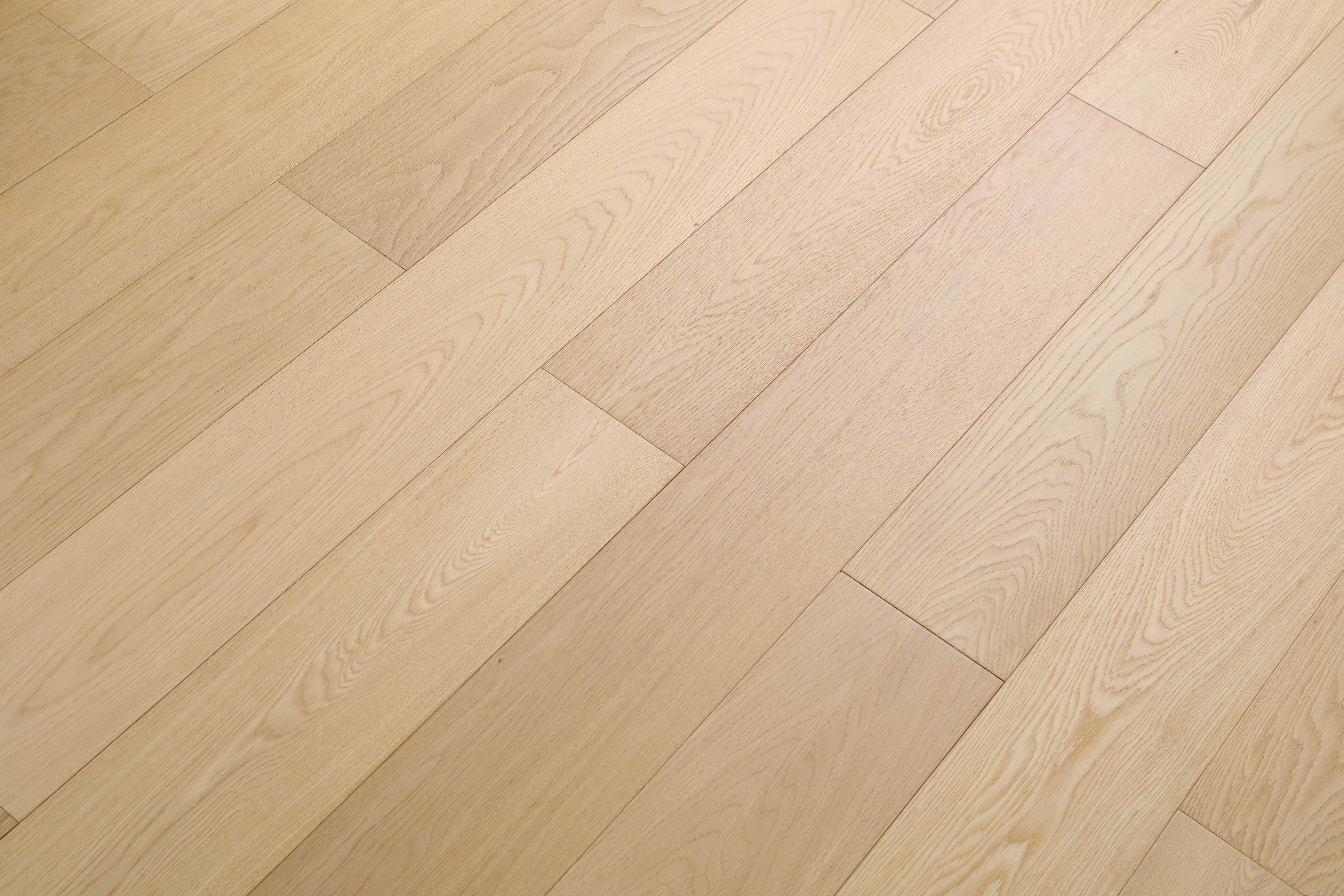
Andiwilson supplies black walnut solid hardwood flooring as a ¾-inch milled product for nail-down installation over approved wood subfloors, with the species positioned on its actual merits rather than on hardness claims it cannot support. The construction uses Juglans nigra heartwood, graded for colour consistency and machined to a tongue-and-groove profile suited to cleat or staple fastening. The installation envelope follows solid hardwood practice: subfloor moisture content below 12%, a differential of no more than 4% between subfloor and flooring, relative humidity held between 35% and 55%, and a minimum acclimation period that runs longer for walnut than for many domestic species because the material dries slowly. Andiwilson documents the colour range and sapwood allowance explicitly, because walnut’s heartwood-sapwood contrast is greater than most hardwoods and a buyer who has not seen the grade tolerance may mistake natural variation for a defect. The specification states what walnut is good at—depth of tone, straight-grain machining, and a surface that takes a hardwax oil or lacquer finish evenly—and what it requires: a realistic expectation of surface indentation under concentrated point loads, and a moisture-managed interior for the life of the floor.
Frequently Asked Questions

Is walnut solid hardwood suitable for high-traffic areas?

With qualifications. Walnut’s 1,010 lbf Janka rating is lower than red or white oak, so it is more prone to indentation from concentrated loads and grit. For residential living areas, bedrooms, and light commercial lounges, it performs well. For heavy-traffic public concourses, a harder species or a commercial-grade finish with a strict maintenance protocol is the more defensible choice.
Solid hardwood guidance generally holds the moisture content of the flooring within 2% to 4% of the subfloor, with 4% commonly treated as the maximum acceptable difference. The subfloor itself should not exceed 12% moisture content. Exceeding these limits raises the risk of cupping, crowning, or end-joint gapping after installation.
Solid hardwood generally requires 7 to 14 days of acclimation in the installation environment, and walnut may need the longer end of that range because it dries slowly and can be slower to reach moisture equilibrium. Acclimation should be judged by moisture-content readings rather than a fixed calendar period, with the HVAC system operating and humidity held between 35% and 55%.
Generally not. Walnut is valued for its natural heartwood colour and is rarely stained, because the species already carries a deep brown-to-chocolate tone that many finishes simply seal rather than alter. A clear hardwax oil or a matte lacquer preserves the natural colour; darker stains can obscure the grain variation that makes the species distinctive.
Black walnut is generally regarded as having good to average dimensional stability, with a tangential shrinkage of approximately 7.8% and a shrinkage ratio of 1.4, which indicates relatively balanced radial and tangential movement. It is not dramatically less stable than oak, but it is softer, so the practical difference in service is surface wear rather than movement.

Related article

Quartz Fiber Board for Medical and Commercial Buildings: A New Generation of A-Class Fireproof Decorative Wall Panels

30

Jul

Quartz Fiber Board for Medical and Commercial Buildings: A New Generation of A-Class Fireproof Decorative Wall Panels

View More
Prefabricated Modular Walls Take Another Leap Forward! Integrated Invisible Door Solutions Redefine the Boundaries of Spatial Aesthetics and Practicality

26

Jul

Prefabricated Modular Walls Take Another Leap Forward! Integrated Invisible Door Solutions Redefine the Boundaries of Spatial Aesthetics and Practicality

View More
What Makes Compact Laminate the Ultimate Choice for High-Moisture Environments?

29

Sep

What Makes Compact Laminate the Ultimate Choice for High-Moisture Environments?

The Failure Point Is Almost Never the Face Most moisture damage in built environments does not start on the visible surface. It starts at a cut edge, a drilled hole, a seam, or a junction where one material meets another. A laminate-faced MDF board...
View More
How to Choose the Right High Pressure Laminate Finish for Your Interior Surfaces?

19

Oct

How to Choose the Right High Pressure Laminate Finish for Your Interior Surfaces?

Start With the Wear Layer, Not the Color Card High pressure laminate finish selection often begins with a color card and a visual preference. That sequence is backward. The finish on an HPL surface is a performance layer before it is a decorative lay...
View More

Feedback from Installers and Design-Led Buyers

Nathan Cole

We supplied and installed ¾-inch solid walnut for a 110-square-metre hotel lounge where the designer wanted a floor that read dark without a stain. The colour range across bundles was wider than the client expected, so we opened several bundles at once and blended them across the room, which is standard practice for walnut. Moisture readings were 8% on the plywood and 7% on the flooring, within the 4% differential, and the floor has stayed flat through one heating season. The client accepted that walnut will mark more readily than oak; that was part of the brief from the start.

Elena Marsh

From an installer’s perspective, walnut is one of the easier hardwoods to work: it cuts cleanly, nails without splitting, and sands evenly. We laid about 70 square metres over a plywood subfloor, holding the site at 45% relative humidity for the acclimation period, which ran closer to two weeks than the minimum three days some solid products allow. The boards engaged well at the end joints, and the finish took evenly. The only callbacks have been minor surface indentations near a desk chair, which the owner expected after we explained the Janka difference with oak.

Get a Free Quote

Our representative will contact you soon.
Email
Mobile/WhatsApp
Name
Company Name
Message
0/1000
Janka 1,010 Sets the Maintenance Conversation, Not the Sale

Janka 1,010 Sets the Maintenance Conversation, Not the Sale

Walnut’s hardness rating is not a defect to be explained away; it is the basis of an honest specification. At 1,010 lbf, the species sits below red oak and white oak, which means it will show surface indentation from concentrated point loads and grit sooner than harder floors. That does not make it unsuitable for flooring, but it does make furniture pads, entry mats, and a realistic patina expectation part of the specification rather than afterthoughts. A walnut floor sold on hardness will generate complaints; a walnut floor sold on colour and maintained accordingly will not.
Moisture Differential Is the Load-Bearing Installation Variable

Moisture Differential Is the Load-Bearing Installation Variable

Solid walnut behaves predictably when the subfloor and the flooring are close to moisture equilibrium. The guidance sets the subfloor at 12% moisture content or below and the differential between wood and subfloor at no more than 4%. These figures are not conservative window dressing. They define the range within which the floor can expand and contract without cupping or gapping. A walnut installation that omits moisture verification has left the most consequential variable to chance, regardless of how carefully the planks were milled.
Colour Variation Is a Grade Characteristic, Not a Quality Failure

Colour Variation Is a Grade Characteristic, Not a Quality Failure

Walnut’s heartwood ranges from pale brown to dark chocolate, and the sapwood is distinctly lighter, often cream or tan. Some mills steam the lumber to reduce that contrast; air-dried material preserves more variation. Neither approach is inherently better, but the buyer should know which grade tolerance applies before the floor arrives. Blending bundles across the installation, as with any natural hardwood, is standard practice. Treating normal colour variation as a warranty issue usually signals a specification conversation that did not happen early enough.
onlineONLINE