WPC Hybrid Flooring: Softer Feel, Click-Lock Ease & Acoustic Benefits

Get a Free Quote

Our representative will contact you soon.
Email
Mobile/WhatsApp
Name
Company Name
Message
0/1000

Comfort-Layer Positioning Between Rigid SPC and Laminate

Wpc hybrid flooring occupies a specific position in the resilient flooring spectrum: softer and warmer underfoot than rigid stone-plastic composite, yet more dimensionally forgiving over minor subfloor variation than thin laminate. Industry analysis places the global WPC flooring market at USD 7.16 billion in 2025, with projections indicating a 10.38% CAGR through 2034, driven partly by renovation activity and demand for comfortable, click-installed floors in residential and light commercial settings. The foamed wood-plastic core reduces impact noise at the source and conforms slightly underfoot, which addresses the hollow feel often reported with harder cores in upper-floor rooms and hospitality spaces.
Get A Quote

Case Study

Upper-Floor Apartment Retrofit with Acoustic Sensitivity

A property manager responsible for a multi-unit residential building sought a floor covering for upper-level apartments where impact noise between storeys had generated repeated resident complaints. A WPC plank with an attached acoustic underlay was specified, carrying laboratory ratings in the range of IIC 63 and STC 61 for the tested assembly. Installation was phased unit by unit using the click-lock format, limiting disruption to occupied homes. Post-installation walkthroughs recorded a reduction in noise-related work orders compared with the prior hard surface, and the slightly cushioned feel underfoot was noted favourably by residents.

Ground-Floor Café with Moisture and Cleaning Demands

A café operator required a floor capable of handling routine spills, daily damp mopping, and moderate commercial foot traffic without the cold, hard feel of tile. The chosen WPC construction incorporated a commercial-grade wear layer and a closed-edge click profile to limit surface water ingress. Over an initial service period, the floor maintained joint integrity in the seating and service zones, and staff reported that cleaning required less water than the previous hard surface. The core’s water resistance, rather than full waterproof classification, was matched to the venue’s indoor, spill-managed environment.

Light Commercial Office Over a Refurbished Subfloor

An office refurbishment involved a existing concrete subfloor with minor undulations that would have required extensive levelling for a thinner, fully rigid plank. The WPC hybrid’s 8mm foamed core and attached underlay accommodated slight variation without telegraphing through the surface, reducing preparation scope. In open-plan workstations and a meeting suite, the acoustic softening helped lower reflected footfall noise. The installer noted that the drop-lock joints engaged consistently across the area, and the facility team valued the ability to lift and replace individual planks in high-wear zones.

Related products

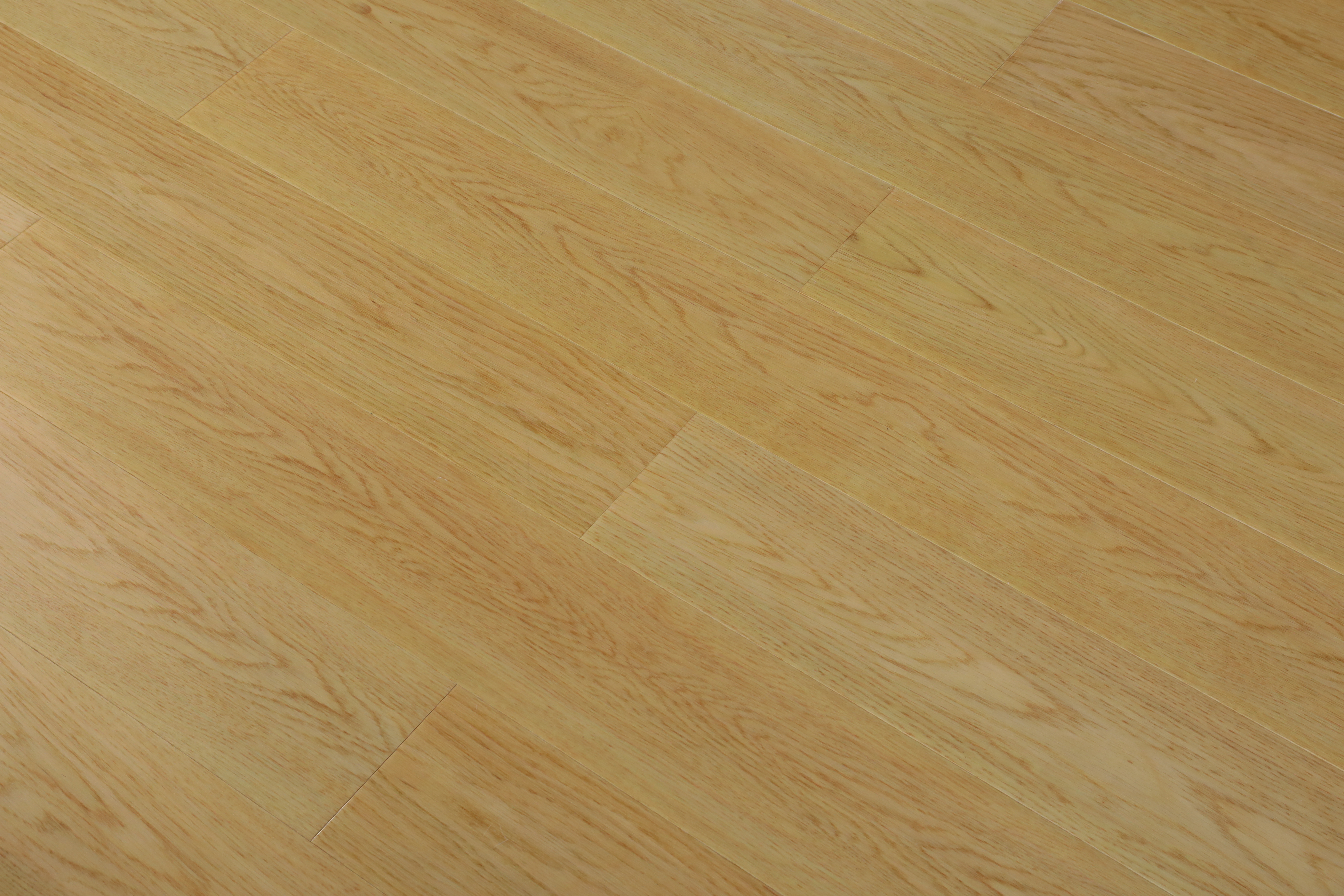
Andiwilson supplies WPC hybrid flooring as a defined construction, not as a generic “hybrid” label. The distinction matters because the category spans cores with different densities, wear layers from residential films to commercial films, and acoustic treatments that may or may not be integrated. The WPC plank offered here uses a foamed wood-plastic composite core in the 6.5mm to 8.5mm range, paired with a click-lock profile machined for consistent engagement across large continuous areas. Wear-layer options are mapped to traffic class: lighter films for bedrooms and living areas, and thicker commercial-grade films where castors, grit, and frequent cleaning are routine. Acoustic performance depends on the assembly; attached IXPE or cork pads can move impact ratings into the IIC 60s and STC 50s–60s in tested configurations, but the final number should be verified for the specific build-up. Documentation covers construction, wear-layer thickness, underfloor-heating compatibility limits, and maintenance expectations, so specifiers can compare the product against project conditions rather than marketing claims.
Frequently Asked Questions

Is WPC hybrid flooring fully waterproof or only water-resistant?

The core is generally water-resistant rather than fully waterproof in the way an SPC core is. It handles spills, damp cleaning, and normal indoor humidity, but standing water at joints or prolonged wet conditions should be avoided. For bathrooms or laundry areas, confirm the manufacturer’s stated exposure limits before specifying.
Compatibility varies by product and must be confirmed in writing. Where approved, surface temperatures are typically capped around 27°C to 28°C, and gradual ramp-up protocols apply. The foamed core can slow heat response compared with denser SPC, so the system design should account for slightly longer warm-up times.
SPC generally has a lower thermal expansion coefficient and is the more dimensionally stable core under temperature fluctuation. WPC is softer and more acoustic but can expand and contract slightly more. For large glazed areas or climates with sharp temperature swings, perimeter allowances and product-specific stability data should be reviewed carefully.
Light commercial specifications commonly use a 0.3mm to 0.5mm wear layer, often corresponding to AC4 or AC5 abrasion ratings depending on the testing standard applied. Heavier commercial environments may require a 0.5mm or thicker film. The wear layer should be matched to traffic type, not selected on thickness alone.
Not necessarily. Some WPC planks include an attached IXPE or cork pad that contributes to impact-sound reduction, simplifying installation and avoiding a separate membrane. If the project has a specific acoustic target, request the tested assembly’s IIC and STC values rather than relying on generic claims about the core alone.

Related article

Quartz Fiber Board for Medical and Commercial Buildings: A New Generation of A-Class Fireproof Decorative Wall Panels

30

Jul

Quartz Fiber Board for Medical and Commercial Buildings: A New Generation of A-Class Fireproof Decorative Wall Panels

View More
What Makes Compact Laminate the Ultimate Choice for High-Moisture Environments?

29

Sep

What Makes Compact Laminate the Ultimate Choice for High-Moisture Environments?

The Failure Point Is Almost Never the Face Most moisture damage in built environments does not start on the visible surface. It starts at a cut edge, a drilled hole, a seam, or a junction where one material meets another. A laminate-faced MDF board...
View More
Why Should Designers Use Custom Textured Wall Panels for Feature Walls?

07

Oct

Why Should Designers Use Custom Textured Wall Panels for Feature Walls?

A Feature Wall Is a Working Surface, Not a Backdrop Designers often choose a feature wall from a rendering first. A bold texture or metallic finish looks convincing in perspective, then the built wall reveals problems the image never showed: glare fr...
View More
How to Choose the Right High Pressure Laminate Finish for Your Interior Surfaces?

19

Oct

How to Choose the Right High Pressure Laminate Finish for Your Interior Surfaces?

Start With the Wear Layer, Not the Color Card High pressure laminate finish selection often begins with a color card and a visual preference. That sequence is backward. The finish on an HPL surface is a performance layer before it is a decorative lay...
View More

Feedback from Trade Specifiers and Installers

Elena Voss

We specified WPC hybrid for a 95-square-metre upper-floor apartment because the client wanted a softer feel than SPC and was concerned about impact noise. The attached pad simplified the installation, and the click joints stayed tight through the first heating season. The surface has handled a household with pets without visible scuffing, and cleaning is straightforward. What we appreciated most was the clear documentation on underfloor-heating limits, which made the specification review with the building surveyor much smoother than usual.

Marcus Hale

From an installer’s perspective, WPC behaves differently from SPC under the knife and around door frames. This plank cut cleanly, and the locking profile engaged without the force sometimes needed on denser cores. We laid about 60 square metres over a slightly uneven concrete floor, and the foamed core absorbed minor undulation without rocking. The client chose a mid-range wear layer for a home office and hallway, and after six months of daily use the surface still cleans up with a damp mop.

Get a Free Quote

Our representative will contact you soon.
Email
Mobile/WhatsApp
Name
Company Name
Message
0/1000
Softer Underfoot Feel Without Sacrificing Click-Lock Convenience

Softer Underfoot Feel Without Sacrificing Click-Lock Convenience

The foamed WPC core gives the floor a slightly cushioned quality that many occupants associate with warmth and comfort, particularly in bedrooms, living areas, and hospitality settings. This feel comes without the need for adhesive or separate underlay in many constructions, because the click-lock format allows floating installation over suitable subfloors. For projects where occupant comfort is a stated priority alongside quick installation, WPC hybrid offers a middle path between hard rigid cores and soft textile surfaces.
Acoustic Contribution Depends on the Tested Assembly

Acoustic Contribution Depends on the Tested Assembly

WPC flooring can contribute to impact-sound reduction, but the final rating depends on the complete build-up: core thickness, attached pad, subfloor, and ceiling assembly. Published test reports for WPC assemblies with IXPE underlay show IIC values ranging from the low 50s to the 70s and STC values in a similar band. Specifiers should request the test report for the exact product and pad combination under consideration rather than extrapolating from core material alone.
Defined Underfloor-Heating Limits Support Responsible Specification

Defined Underfloor-Heating Limits Support Responsible Specification

Where WPC hybrid is approved for underfloor heating, the approval is conditional: surface temperature is typically capped near 27°C to 28°C, and gradual commissioning is required. The foamed core’s insulating effect means heat response may be slower than with denser cores, but when the system is designed accordingly, the floor can operate without exceeding the manufacturer’s stated limits. Clear disclosure of these conditions allows the specifier to assess suitability before installation rather than after.
onlineONLINE